
Spondylolisthesis means one vertebra in the spine has slipped forward over the one below it, which can cause back pain and leg pain by narrowing the space for the nerves. Many people, especially with a mild slip, do well with physiotherapy, activity changes and medicines, and surgery is generally reserved for persistent leg symptoms, nerve weakness, or a slip that is worsening.
Patients in Lahore often first hear the word on an X-ray or MRI report and worry that the spine is "out of place". This page explains the different types of slip, what the grades mean, how it is diagnosed, and when treatment such as decompression or fusion may be recommended.
The vertebrae are normally stacked in a smooth line, held by discs, joints and ligaments. In spondylolisthesis, one bone has moved forward relative to the next, most commonly at the lowest two levels of the lower back (L4-L5 or L5-S1). There are two main types.
This is the most common type in adults over 50, and more common in women. Wear of the disc and arthritis in the facet joints make the segment loose, allowing the vertebra to slide forward slowly, usually at L4-L5. It often occurs together with spinal stenosis, because the slip and the thickened tissues narrow the nerve canal.
This type starts with a stress fracture in a thin bridge of bone at the back of the vertebra (the pars interarticularis). That crack is called spondylolysis. It often begins in childhood or the teenage years, particularly in young athletes in sports with repeated backward bending, such as cricket fast bowling, gymnastics, weightlifting and football. If the crack does not heal, the vertebra can slip forward, usually at L5-S1.
Less common types follow injury, previous surgery, bone disease or a congenital difference in the spine.
Doctors grade the slip by how far the vertebra has moved forward over the one below:
The grade is only part of the picture. A small slip that moves when you bend, or that squeezes a nerve, may cause more trouble than a larger stable one.
Many people with a mild slip have no symptoms at all.
Seek emergency care if you develop loss of bladder or bowel control, numbness around the genitals or back passage, or rapidly worsening leg weakness. These may indicate severe nerve compression.
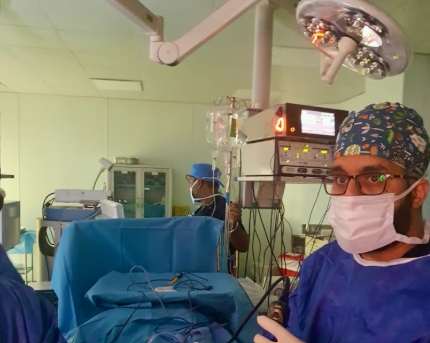
At consultation, Dr. Khawar Anwar takes a history, examines your back, nerves and walking, and reviews your imaging.
Most grade 1 and many grade 2 slips are managed without an operation.
Children and teenagers with a known slip are usually followed with periodic X-rays during growth to make sure it is not progressing.
Freeing the trapped nerves by removing thickened ligament, bone spurs or part of the lamina. In selected older patients with a mild, stable degenerative slip and mainly leg symptoms, decompression alone may be enough.
When the segment is unstable, the nerves are freed and the two vertebrae are then joined (fused) so they no longer slide. Screws are placed into the vertebrae and connected with rods to hold them while the bone heals. Two common ways of doing this are:
In suitable patients, the screws and rods can be placed through small skin incisions with X-ray or navigation guidance, rather than stripping the back muscles widely. This can mean less muscle damage, less blood loss and a quicker start to walking. Read more about minimally invasive spinal fixation.
For some young patients with spondylolysis but little or no slip and a healthy disc, the crack itself can be repaired, avoiding fusion.
Slips caused by injury are covered on our spinal fracture surgery page, and other operations on our spine surgery page.
Risks include infection, bleeding, nerve injury, dural tear, screw misplacement or loosening, failure of the bones to fuse, blood clots, and later wear at the level above or below the fusion. These are discussed with you individually.
No, the slip itself usually stays, but symptoms often settle with exercise and treatment. The goal is to control pain and protect the nerves, not to make the X-ray look perfect.
No. A slip disc is soft disc material bulging out and pressing on a nerve. Spondylolisthesis is a whole vertebra moving forward. They can cause similar leg pain, but the treatment is different.
It is possible, especially in fast bowlers with pain on bending backwards. He should stop bowling and have an assessment; caught early, a stress fracture can often heal with rest and a brace.
Not necessarily. Many patients need no surgery, and some need decompression alone. Fusion is mainly for unstable or higher-grade slips.
Bring your X-rays, including bending views if available, and your MRI. You can book an appointment for a consultation.
Dr. Khawar Anwar is a Consultant Neurosurgeon & Spine Surgeon at PINS / Lahore General Hospital, Lahore, with over 10 years of experience in brain and spine surgery. He sees patients in Lahore and Gujranwala and focuses on minimally invasive and endoscopic techniques where they are suitable for the patient.
See the full list on the certifications page or read more about Dr. Khawar Anwar.
See all clinics, maps and timings on the locations page.
To book, call or WhatsApp 0333-7574732 and tell us which clinic and day suits you. Please bring your MRI or CT scan (films and CD), reports and a list of your current medicines to the consultation. For sudden weakness, loss of bladder or bowel control, a sudden severe headache or a head or spine injury, go to the nearest emergency department first.