
Most people with back or neck pain never need spine surgery. Surgery is usually considered only when a nerve or the spinal cord is being compressed and symptoms such as leg or arm pain, numbness or weakness have not settled with good non-surgical care, or when there is an emergency such as loss of bladder control or a fracture that makes the spine unstable.
This page gives an overview of the spine conditions Dr. Khawar Anwar treats in Lahore, the main types of spine surgery, and how to decide whether you need a specialist opinion. Each condition and procedure has its own page with more detail, linked below.
Spine surgery covers operations on the neck (cervical spine), mid-back (thoracic spine) and lower back (lumbar spine). The aim is usually one or more of three things: to take pressure off a nerve or the spinal cord (decompression), to hold an unstable segment of the spine steady (stabilisation or fusion), or to repair an injury. Surgery treats the specific cause found on examination and MRI. It does not cure general back ache from muscles, posture or age-related wear on its own.
A slip disc happens when the soft centre of a disc pushes out and presses on a nerve, often causing sharp leg pain or arm pain. Most improve within weeks without an operation. Read more about slip disc treatment, including when surgery is advised.
Sciatica is pain running from the buttock down the back of the leg, caused by irritation of a lumbar nerve root. It is a symptom rather than a diagnosis, so finding the cause matters. See sciatica treatment for causes, home care, injections and surgery.
Spinal stenosis is narrowing of the spinal canal, usually from age-related thickening of ligaments and joints. It typically causes heaviness or pain in both legs on walking that eases on sitting or bending forward. Learn about spinal stenosis surgery and the non-surgical options tried first.
Wear in the neck discs and joints can cause neck stiffness, arm pain from a pinched nerve, or, more seriously, pressure on the spinal cord (myelopathy) with clumsy hands and unsteady walking. Read about cervical spondylosis treatment.
In spondylolisthesis one vertebra slips forward on the one below, which can narrow the space for nerves and cause back pain and leg symptoms. Some patients need stabilisation. See spondylolisthesis treatment.
Fractures may follow a fall, road accident, or minor injury in someone with weak bones (osteoporosis). Many stable fractures heal with a brace and rest; unstable fractures or those pressing on the cord may need fixation. Read about spinal fracture surgery.
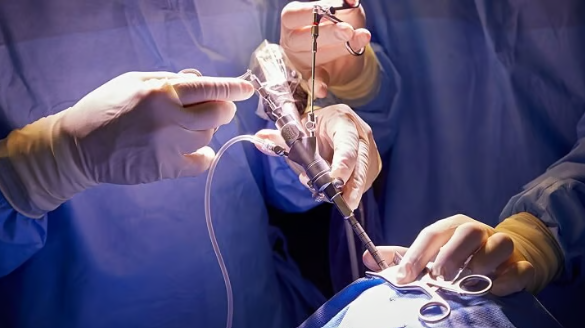
Endoscopic spine surgery uses a thin camera and fine instruments passed through a small incision to remove a disc fragment or relieve narrowing. It suits selected patients, mainly with a single-level problem. See endoscopic spine surgery for who may be suitable.
Endoscopic discectomy is the specific endoscopic operation to remove a herniated disc fragment pressing on a nerve. Details are on the endoscopic discectomy page.
Microdiscectomy removes a disc fragment through a small open incision using an operating microscope. It is a long-established operation for slip disc and remains a good option when endoscopic surgery is not suitable.
Decompression (laminectomy or laminotomy) removes bone and thickened ligament to widen a narrowed canal, most often for spinal stenosis.
Fixation and fusion uses screws and rods, sometimes with a spacer in the disc space, to hold an unstable segment so it can fuse. This is used for some cases of spondylolisthesis, fractures, deformity or instability. Where suitable, this can be done through smaller incisions, described on the minimally invasive spinal fixation page.
Surgery is usually not needed for back pain without nerve symptoms, for a slip disc that is steadily improving, or for wear seen on an MRI that does not match your symptoms. Many MRI findings are common in people with no pain at all.
Surgery may be advised when:
Go to an emergency department immediately if you develop numbness around the back passage or genitals, new difficulty passing urine or controlling bladder or bowels, or rapidly worsening weakness in both legs. These can be signs of cauda equina syndrome or cord compression, which need urgent assessment.
It is sensible to see a spine specialist if pain spreads down an arm or leg, if you have numbness or weakness, if pain is not improving after several weeks, or if your MRI report mentions nerve or cord compression. A neurosurgeon is trained in operations on the brain, spinal cord and nerves, and can also advise you when surgery is not the right answer.
At consultation, Dr. Khawar Anwar takes a history of your symptoms, examines strength, sensation and reflexes, and reviews your MRI or other scans. Please bring all previous reports, films and a list of medicines. If no scan has been done, one may be requested. You will then be told whether your symptoms match the scan, what non-surgical options remain, and, if surgery is reasonable, which operation would suit your problem and what recovery to expect.
Most patients are first offered medicines, activity advice and physiotherapy, and sometimes a targeted injection. If surgery is needed, the smallest operation that will properly treat the problem is preferred. Endoscopic or other minimally invasive techniques are used where they are suitable, but open surgery is still the right choice for some conditions, and that decision is made case by case.
Not necessarily. Disc bulges are very common, even in people without pain. Surgery depends on whether the scan finding matches your symptoms and examination, and on how you respond to non-surgical treatment.
All surgery carries risks, such as infection, bleeding, nerve injury or a spinal fluid leak, but serious complications are uncommon in well-selected patients. Your specific risks depend on the operation and your general health and will be discussed before any decision.
After most disc and decompression operations, patients are usually helped to walk the same day or the next day. Recovery after fusion or fracture surgery is usually slower. Timelines depend on the procedure and your condition before surgery.
For suitable patients it can mean a smaller incision and a quicker return to activity, but it is not suitable for every problem. The best operation is the one that safely treats your specific cause.
You can book an appointment online or by phone. Bring your MRI and any previous reports.
Dr. Khawar Anwar is a Consultant Neurosurgeon & Spine Surgeon at PINS / Lahore General Hospital, Lahore, with over 10 years of experience in brain and spine surgery. He sees patients in Lahore and Gujranwala and focuses on minimally invasive and endoscopic techniques where they are suitable for the patient.
See the full list on the certifications page or read more about Dr. Khawar Anwar.
See all clinics, maps and timings on the locations page.
To book, call or WhatsApp 0333-7574732 and tell us which clinic and day suits you. Please bring your MRI or CT scan (films and CD), reports and a list of your current medicines to the consultation. For sudden weakness, loss of bladder or bowel control, a sudden severe headache or a head or spine injury, go to the nearest emergency department first.