
Cervical spondylosis is age-related wear and tear of the discs and joints in the neck, and most people with it are treated successfully without surgery using posture correction, physiotherapy and medicines. Surgery is usually only considered when a nerve or the spinal cord is being squeezed and causing persistent arm pain, weakness, or problems with hand use and balance.
Neck pain is very common among office workers, drivers, students and anyone who spends long hours looking down at a phone. For patients in Lahore, this page explains what cervical spondylosis is, which symptoms are harmless and which need attention, and what the treatment options involve.
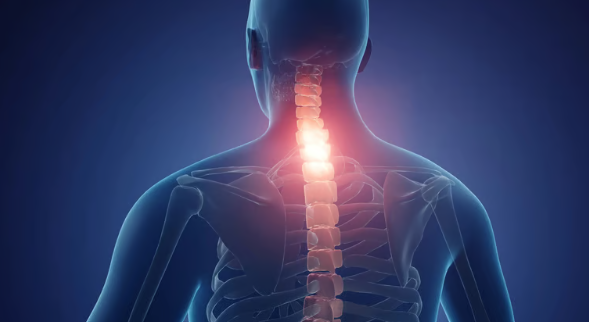
The neck has seven vertebrae separated by cushioning discs. With age, the discs dry out and lose height, the small joints at the back develop arthritis, and the body forms bony spurs (osteophytes) along the edges of the bones. This combination is called cervical spondylosis. It shows up on X-rays in most people over 50, often with no symptoms at all.
Problems arise in three main ways: the worn joints themselves cause neck pain and stiffness; a spur or disc bulge pinches a nerve root, causing arm pain (radiculopathy); or the canal narrows enough to press on the spinal cord (myelopathy).
The most common symptom is an aching, stiff neck, often worse in the morning or after long periods at a desk. Pain may spread to the shoulder blades and the back of the head, causing headaches. Grinding or cracking on turning the neck is common and usually harmless.
When a nerve root is pinched, pain shoots from the neck into the shoulder, arm or hand, often along a specific line. There may be tingling, numbness, or weakness in certain fingers or muscles, such as difficulty gripping. This can also be caused by a herniated disc in the neck; see our slip disc treatment page for disc problems.
This is the most important form to recognise because it can cause lasting damage. Warning signs include:
Myelopathy is a form of spinal stenosis in the neck. If you notice these signs, arrange a specialist review soon. If weakness, falls or bladder problems develop quickly, go to an emergency department.
At consultation, Dr. Khawar Anwar asks about your neck pain, arm symptoms, hand function and walking, and examines strength, sensation, reflexes and balance. Some examination signs, such as brisk reflexes, point towards spinal cord involvement.
Most neck pain from cervical spondylosis, and many cases of arm pain from a pinched nerve, settle with non-surgical care over weeks to a few months.
Treatments that promise to permanently cure neck wear quickly, or forceful neck manipulation, should be approached with caution, especially if you have arm or hand symptoms.
Neck pain alone, without nerve or cord compression, is rarely a reason for surgery.
The operation is chosen according to where the compression is, how many levels are involved, and the alignment of the neck. Your options are explained in detail before any decision.
Through a small incision at the front of the neck, the worn disc and bone spurs are removed to free the nerve or cord. A spacer is placed in the gap, often with a small plate, so that the two vertebrae heal together. This is one of the most commonly performed neck operations.
Instead of fusing, the removed disc is replaced with an artificial disc designed to preserve movement. It suits selected patients, usually younger, with a soft disc problem at one or two levels and without significant arthritis in the joints.
For a single pinched nerve on one side, the opening where the nerve exits can be widened from the back of the neck without fusion. This can sometimes be done with minimally invasive or endoscopic techniques.
When the spinal cord is compressed over several levels, the canal can be widened from the back. In laminoplasty, the bony roof is hinged open and held in a wider position. Laminectomy removes it, often with fixation to keep the neck stable.
See our spine surgery page for an overview of other spinal procedures.
Arm pain often improves early. Numbness and weakness can take months. With myelopathy, the main aim is to prevent worsening, and improvement in hand function and balance varies.
Risks include temporary swallowing difficulty or hoarseness after front surgery, infection, bleeding, nerve or spinal cord injury (rare), a fluid leak, failure of fusion, and problems developing at neighbouring levels over the years. Your individual risks are discussed before surgery.
The wear changes cannot be reversed, but symptoms usually can be controlled. Many people with spondylosis on X-ray live without significant pain, especially with good posture and regular exercise.
Dizziness is often blamed on the neck but usually has other causes, such as inner ear, blood pressure or other medical problems. It should be checked properly rather than assumed to be from the neck.
Most patients do not. Surgery is mainly for nerve or spinal cord compression that causes persistent arm pain, weakness or myelopathy.
A one- or two-level fusion usually causes only a small loss of movement that most people barely notice in daily life. Disc replacement may be an option for some patients who want to preserve movement.
Bring any X-rays, MRI scans and reports, and a list of medicines. You can book an appointment online.
Dr. Khawar Anwar is a Consultant Neurosurgeon & Spine Surgeon at PINS / Lahore General Hospital, Lahore, with over 10 years of experience in brain and spine surgery. He sees patients in Lahore and Gujranwala and focuses on minimally invasive and endoscopic techniques where they are suitable for the patient.
See the full list on the certifications page or read more about Dr. Khawar Anwar.
See all clinics, maps and timings on the locations page.
To book, call or WhatsApp 0333-7574732 and tell us which clinic and day suits you. Please bring your MRI or CT scan (films and CD), reports and a list of your current medicines to the consultation. For sudden weakness, loss of bladder or bowel control, a sudden severe headache or a head or spine injury, go to the nearest emergency department first.