
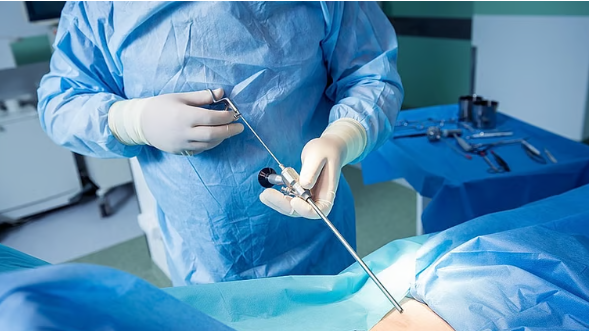
Endoscopic spine surgery is a minimally invasive operation in which a thin camera (endoscope) and fine instruments are passed through a small incision to take pressure off a trapped spinal nerve. For suitable patients in Lahore with a slip disc, sciatica or localised spinal narrowing, it can relieve leg or arm pain with less muscle disturbance than open surgery, but it is not the right operation for every spine problem.
Many patients ask about "laser spine surgery". This is a term patients often use. In practice, the main work in endoscopic spine surgery is done with the endoscope and small mechanical instruments that remove disc material, bone or ligament. A radiofrequency or laser probe may sometimes be used to control bleeding or shrink a small amount of tissue, but a laser alone does not "melt away" a slip disc.
The endoscope is a tube about the width of a pencil that carries a camera, a light and a channel for instruments. Saline (sterile salt water) flows through it continuously to keep the view clear. The surgeon watches a high-definition screen while removing whatever is pressing on the nerve. Because the endoscope works through a narrow corridor, back muscles are gently pushed aside rather than cut and stripped from the bone.
There are two main routes. The transforaminal route enters from the side through the natural opening where the nerve leaves the spine. The interlaminar route enters from the back between two vertebrae. The choice depends on the level and position of the problem.
The specific operation to remove a herniated disc fragment is described in more detail on the endoscopic discectomy page.
You may be suitable if:
Endoscopic surgery may not be suitable if:
At consultation, Dr. Khawar Anwar examines your strength, sensation and reflexes and reviews your MRI to confirm the problem matches your symptoms. Sometimes X-rays taken while bending forward and back are needed to check for instability, or a CT scan to look at bone. Routine blood tests, an ECG and an anaesthetic assessment are usually arranged. You will be told which blood-thinning or diabetes medicines to stop or adjust.
The operation commonly takes around one to two hours, depending on the complexity.
Endoscopic surgery is generally well tolerated, but it is still surgery. Risks include:
Open or microscope-assisted surgery may be the better option when the spine is unstable and needs screws and rods, when several levels are narrowed, when there is deformity, tumour or infection, or when a previous operation has left scar tissue that makes the endoscopic route unsafe. A conventional microdiscectomy also remains an excellent operation for many slip discs. The aim is to choose the operation that safely and fully treats your problem, not simply the smallest incision. The spine surgery page outlines the other options.
Not exactly. "Laser spine surgery" is a popular term, but the important part of the operation is done with an endoscope and mechanical instruments. A laser or radiofrequency probe, if used, plays a small supporting role.
Some endoscopic operations are done under local anaesthesia with sedation, which allows you to report leg sensations. Others are done under general anaesthesia. This is decided with you and the anaesthetist.
Yes, a recurrent herniation can occur at the same level after any type of disc surgery. It is most likely in the first months. Avoiding heavy lifting early on and keeping active with core exercises may help.
Age alone is not a barrier. Suitability depends on the problem shown on MRI, spinal stability and general health. Some older patients with stenosis at one level do well with this approach.
Book an appointment and bring your MRI and any previous reports so your scans and symptoms can be assessed together.
Dr. Khawar Anwar is a Consultant Neurosurgeon & Spine Surgeon at PINS / Lahore General Hospital, Lahore, with over 10 years of experience in brain and spine surgery. He sees patients in Lahore and Gujranwala and focuses on minimally invasive and endoscopic techniques where they are suitable for the patient.
See the full list on the certifications page or read more about Dr. Khawar Anwar.
See all clinics, maps and timings on the locations page.
To book, call or WhatsApp 0333-7574732 and tell us which clinic and day suits you. Please bring your MRI or CT scan (films and CD), reports and a list of your current medicines to the consultation. For sudden weakness, loss of bladder or bowel control, a sudden severe headache or a head or spine injury, go to the nearest emergency department first.