
Most people with a slip disc do not need surgery. In many patients the pain improves noticeably within 6 to 12 weeks with medicines, activity and physiotherapy, as the body gradually shrinks the herniated material. Surgery is usually advised only if severe nerve pain persists, weakness is getting worse, or there are emergency signs such as loss of bladder control.
This page explains slip disc in the lower back and neck, how it is diagnosed, the non-surgical and surgical treatment available in Lahore, and how to recognise when you need urgent help.
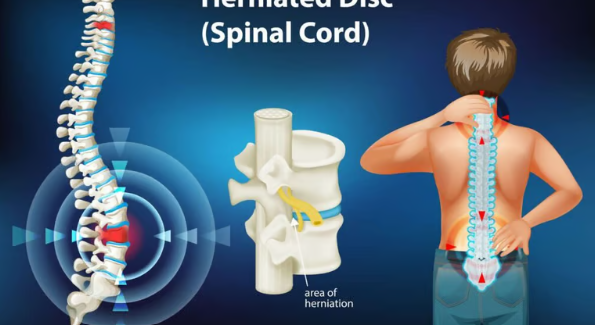
Between each pair of vertebrae is a disc that acts as a shock absorber. It has a tough outer ring and a soft gel-like centre. A "slip disc" does not actually slip out of place. Instead, the outer ring tears and part of the soft centre bulges or breaks through. Doctors call this a disc herniation or prolapse. If the herniated material touches a nearby nerve, it causes inflammation and pain along that nerve.
Lumbar slip disc (lower back) is the most common type, usually at the L4-L5 or L5-S1 levels. It typically causes sciatica, a pain running from the buttock down the leg.
Cervical slip disc (neck) usually affects the C5-C6 or C6-C7 levels and causes pain spreading from the neck into the shoulder blade, arm and hand.
Lumbar slip disc:
Cervical slip disc:
A large lumbar disc can compress the bundle of nerves at the bottom of the spine, called cauda equina syndrome. Go to the emergency department immediately, day or night, if you have:
With a neck disc, clumsy hands, difficulty with buttons or writing, or unsteady walking can mean pressure on the spinal cord and also need prompt assessment.
Discs naturally lose water and become less flexible with age, making tears more likely from the 30s onwards. Heavy or awkward lifting, repeated bending, long periods of sitting or driving, smoking, being overweight and a family tendency all raise the risk. Often there is no single injury and symptoms start after an ordinary movement.
Diagnosis begins with history and examination. Testing leg raise, reflexes, strength and sensation shows which nerve is affected. An MRI scan confirms the disc herniation and shows its size and position. An MRI is usually not needed in the first few weeks unless there are red flags or weakness, because many discs improve on their own. Importantly, the MRI must match the symptoms; disc bulges are common in people without pain.
When surgery is needed, the aim is to remove the piece of disc pressing on the nerve. Options include:
For more on how the camera-guided approach works and who it suits, see endoscopic spine surgery. Other spinal operations are summarised on the spine surgery page.
Surgery is usually advised when:
Surgery is not usually helpful when back pain is the only symptom without nerve pain.
After disc surgery, patients usually walk the same day. Leg or arm pain often improves early, while numbness can take longer. Many people return to desk work in a few weeks; heavier jobs need longer. A physiotherapy programme and avoiding heavy lifting for around six weeks are usually advised.
Risks are generally low but include re-herniation of the disc at the same level, infection, bleeding, a spinal fluid leak, nerve injury and incomplete relief of symptoms. Your individual risks will be explained before you decide.
Yes, in many people. The herniated material often shrinks over weeks to months, and symptoms settle with time, activity and physiotherapy.
No. A day or two of rest during severe pain is reasonable, but gentle walking and normal activity as tolerated usually lead to faster recovery than prolonged bed rest.
The principles are similar: most improve without surgery. However, signs of spinal cord pressure in the neck, such as clumsy hands or unsteady walking, are taken more seriously and may need earlier surgery.
It can, whether or not you have had surgery. Staying active, keeping a healthy weight, not smoking and lifting correctly may lower the risk.
If pain has not improved after several weeks, if you have weakness or numbness, or if your MRI shows nerve compression, book an appointment. Go to emergency straight away for bladder, bowel or saddle numbness symptoms.
Dr. Khawar Anwar is a Consultant Neurosurgeon & Spine Surgeon at PINS / Lahore General Hospital, Lahore, with over 10 years of experience in brain and spine surgery. He sees patients in Lahore and Gujranwala and focuses on minimally invasive and endoscopic techniques where they are suitable for the patient.
See the full list on the certifications page or read more about Dr. Khawar Anwar.
See all clinics, maps and timings on the locations page.
To book, call or WhatsApp 0333-7574732 and tell us which clinic and day suits you. Please bring your MRI or CT scan (films and CD), reports and a list of your current medicines to the consultation. For sudden weakness, loss of bladder or bowel control, a sudden severe headache or a head or spine injury, go to the nearest emergency department first.