
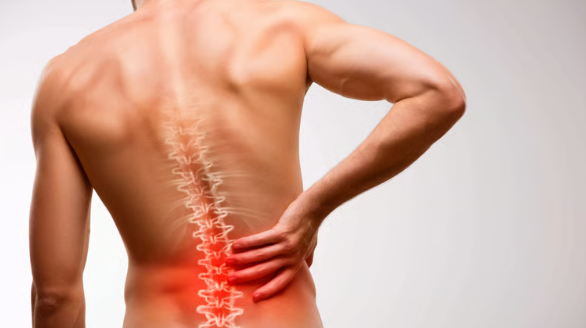
Sciatica is pain that travels from the lower back or buttock down the back of the leg, caused by irritation or pressure on one of the nerve roots that form the sciatic nerve. It is a symptom, not a disease, and treatment depends on finding the cause. Most sciatica improves within weeks with simple care, and only a minority of patients need an injection or surgery.
This page explains the common causes of sciatica, what you can do at home, and when patients in Lahore should seek a specialist opinion or emergency help.
The sciatic nerve is formed from nerve roots leaving the lower spine (mainly L4, L5 and S1). When one of these roots is squeezed or inflamed, pain is felt along the path of that nerve rather than only in the back. Doctors sometimes call this lumbar radiculopathy. Which part of the leg and foot hurts often gives a clue to which nerve root is involved.
If pain affects both legs and comes on with walking, easing when you sit or bend forward, the cause is more likely to be spinal narrowing than a single disc.
Go to an emergency department immediately if sciatica comes with numbness between the legs or around the back passage, new difficulty passing urine or loss of bladder or bowel control, or weakness in both legs. These are signs of cauda equina syndrome. Also seek urgent help if sciatica comes with fever, unexplained weight loss, a history of cancer, or follows a serious injury.
Risk factors include heavy lifting, long hours of sitting or driving, being overweight, smoking and age-related disc wear.
Diagnosis is mostly clinical. The doctor asks about the pattern of pain and checks the straight-leg-raise test, reflexes, strength and sensation. An MRI is usually reserved for pain that has not improved after several weeks, for weakness, or for red flags. It shows whether the cause is a disc, narrowing, or slippage. X-rays taken while bending help assess spondylolisthesis.
A physiotherapist can teach nerve-gliding movements, posture correction and core strengthening. Exercises are adjusted to what eases your leg pain. Physiotherapy is most useful once the most intense pain has calmed.
Anti-inflammatory medicines and, in some cases, medicines specifically for nerve pain may be used. Strong painkillers are best kept short-term because of side effects.
If pain is severe or slow to settle, a selective nerve root block or transforaminal epidural injection can be given. Under X-ray guidance, a small amount of steroid and local anaesthetic is placed beside the inflamed nerve. It does not remove the cause, but it can reduce inflammation and give relief for weeks or longer while the body heals, and it can help confirm which nerve is responsible.
Surgery aims to free the trapped nerve and depends on the cause:
An overview of all options is on the spine surgery page.
Surgery is usually considered when leg pain remains severe after around 6 to 12 weeks of non-surgical treatment, when there is significant or worsening weakness such as foot drop, when walking is badly limited by stenosis, or urgently for cauda equina syndrome. If symptoms are steadily improving, waiting is usually reasonable.
Without surgery, many people feel much better within six weeks, though mild symptoms can linger for a few months. After disc surgery, leg pain often eases quickly and most patients walk the same day. Return to work varies from one or two weeks for desk jobs to several weeks for manual work; recovery after fixation is longer. Numbness usually recovers more slowly than pain.
Risks depend on the operation but include infection, bleeding, spinal fluid leak, nerve injury, recurrence of a disc herniation and incomplete relief. These will be discussed in relation to your own scan and health.
Many episodes improve noticeably within 4 to 6 weeks, and most within about three months. Some people have recurring episodes.
No. A disc is the most common cause in younger adults, but spinal stenosis and spondylolisthesis are common in older people. The cause guides the treatment.
Injections reduce nerve inflammation and pain but do not remove a disc or widen a narrow canal. For many patients they provide enough relief for natural healing to take place.
Usually not, unless there are red-flag symptoms or weakness. If pain persists beyond several weeks or surgery is being considered, an MRI is the key test.
If leg pain is not improving after several weeks, if you have weakness or numbness, or if an MRI shows nerve compression, book an appointment. Bladder or bowel symptoms need the emergency department straight away.
Dr. Khawar Anwar is a Consultant Neurosurgeon & Spine Surgeon at PINS / Lahore General Hospital, Lahore, with over 10 years of experience in brain and spine surgery. He sees patients in Lahore and Gujranwala and focuses on minimally invasive and endoscopic techniques where they are suitable for the patient.
See the full list on the certifications page or read more about Dr. Khawar Anwar.
See all clinics, maps and timings on the locations page.
To book, call or WhatsApp 0333-7574732 and tell us which clinic and day suits you. Please bring your MRI or CT scan (films and CD), reports and a list of your current medicines to the consultation. For sudden weakness, loss of bladder or bowel control, a sudden severe headache or a head or spine injury, go to the nearest emergency department first.