
Endoscopic pituitary surgery removes a pituitary tumour through the nose, using a thin telescope (endoscope), so there is no cut on the face or scalp. It is now the usual operation for most pituitary adenomas, and for patients in Lahore it offers a direct route to the gland without lifting the brain.
The full name is endoscopic endonasal transsphenoidal surgery: "endonasal" means through the nostrils, and "transsphenoidal" means through the sphenoid sinus, an air space at the back of the nose that sits directly below the pituitary gland.
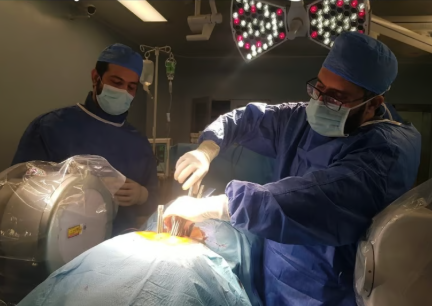
The endoscope gives the surgeon a bright, wide, magnified view on a high-definition screen. Instruments pass alongside it through the nostril to open the thin bone of the sphenoid sinus and the floor of the pituitary fossa, and the tumour is removed piece by piece. It is one of the most established forms of endoscopic brain surgery. Because the approach is from below, the brain itself is not retracted, and recovery is often quicker than with an open operation.
Background on the different tumour types, their symptoms and non-surgical options is on our pituitary tumour page.
Most pituitary adenomas, including many large ones, can be approached through the nose. The endoscopic route may be less suitable when a tumour extends far out to the side of the brain, has a tight "waist" at the diaphragm of the sella with a large portion above it, wraps firmly around major blood vessels, or is very fibrous. Active sinus infection usually needs to be treated before surgery. The decision is individual and is based on your MRI.
The operation commonly takes around two to four hours, depending on the size and nature of the tumour.
Many patients stay in hospital for about two to five days. Nurses measure urine output and blood tests check sodium and cortisol levels, as the pituitary controls the body's water balance and stress hormones. Most people are sitting up and walking within a day.
A blocked nose, mild bloody discharge and crusting are normal for a few weeks. You may be advised to use saline nasal spray or rinses. For the first few weeks, avoid blowing your nose hard, sneezing with your mouth closed, straining, heavy lifting, and drinking through a straw. Report clear watery fluid dripping from the nose, especially when bending forward, as this may be a CSF leak.
Many people return to desk work in about two to four weeks and to more physical work after four to six weeks, depending on recovery. Air travel and driving are usually deferred for a few weeks; your team will advise based on your vision and progress.
Hormone levels are checked in the days and weeks after surgery, and again with the endocrinologist over the following months. A follow-up MRI is usually done after about three months, once swelling has settled, to assess any remaining tumour. Visual fields are repeated. Long-term follow-up with periodic MRI is common, as some adenomas can regrow years later.
Some tumours are better reached through a craniotomy, where a window of bone is opened in the skull. This may be advised when a tumour extends widely beside or above the brain beyond what can be safely reached from below, is very firm and stuck to vessels or nerves, or has an unusual shape. Occasionally both routes are combined or staged. These options are discussed with other brain tumour surgery treatments and on the skull base tumour surgery page.
No. The operation is done entirely through the nostrils. If a small fat graft is needed to seal the repair, it is usually taken from the abdomen or thigh through a small incision.
Most patients describe nasal stuffiness and a sinus-type headache rather than severe pain. This is usually controlled with simple painkillers and settles over a few weeks.
No. The shape of the nose is not changed. Some patients notice a temporary change in smell or nasal congestion while the lining heals.
Yes, some pituitary adenomas can regrow, particularly if part of the tumour could not be safely removed. That is why follow-up MRI scans and hormone checks continue for years.
Bring your pituitary MRI, hormone results and eye test reports. At consultation, Dr. Khawar Anwar reviews these to advise whether surgery through the nose is appropriate. You can book an appointment online.
Dr. Khawar Anwar is a Consultant Neurosurgeon & Spine Surgeon at PINS / Lahore General Hospital, Lahore, with over 10 years of experience in brain and spine surgery. He sees patients in Lahore and Gujranwala and focuses on minimally invasive and endoscopic techniques where they are suitable for the patient.
See the full list on the certifications page or read more about Dr. Khawar Anwar.
See all clinics, maps and timings on the locations page.
To book, call or WhatsApp 0333-7574732 and tell us which clinic and day suits you. Please bring your MRI or CT scan (films and CD), reports and a list of your current medicines to the consultation. For sudden weakness, loss of bladder or bowel control, a sudden severe headache or a head or spine injury, go to the nearest emergency department first.